

Professional detection and diagnosis of hidden damp
We accept card payments on site
- Condensation told apart from an active leak
- Depth moisture readings with moisture meters
- Rising damp identified in basements
- Official technical report
Do you have a problem with unexplained damp, blistered walls, falling plaster or an unpleasant smell at home, in the office, a warehouse, a retail unit, a production hall, a school or a nursery? Finding the source of the damp in good time is the first and most important step before undertaking any repair whatsoever.
ProKanal EOOD offers high-technology, non-destructive damp diagnosis across Bulgaria. With a team of specialists, including an expert certified in Germany, and latest-generation professional equipment, we find the exact cause of the problem without needless demolition and breaking open.
The silent threat: how damp ruins human health
Damp in buildings is rarely just a cosmetic defect. It is a serious, silent threat to the human body. When water soaks imperceptibly into walls or beneath floor coverings, it creates the perfect conditions for toxic micro-organisms, mould and mildew. Their invisible spores spread through the air and are breathed in daily by the occupants, which leads to severe health consequences.
The main side effects and health risks:
- Allergies and skin irritation: Mould spores are a powerful allergen. Prolonged exposure to a damp environment causes chronic allergic rhinitis, red and watering eyes, sneezing, and persistent skin eczema, rashes and dermatitis.
- Respiratory problems and worsening asthma: Breathing air contaminated by damp damages the lungs. It causes chronic coughing, breathlessness and wheezing, and can trigger or seriously worsen the condition of people suffering from asthma.
- Weakening of the immune system: The toxins released by certain kinds of black mould (mycotoxins) suppress immunity. Occupants of damp rooms start to fall ill far more often with viral and bacterial infections.
- Chronic fatigue and headaches: The constant smell of damp and mould degrades sleep quality. This leads to morning headaches, a feeling of exhaustion, poor concentration and chronic fatigue.
The benefits of a dry environment: why clean air is healthier
Locating and fully eliminating damp in good time transforms the quality of life and the indoor climate. Maintaining optimal humidity (between 40% and 60%) brings immediate and long-term health benefits:
- Healthier, cleaner air: Once the source of the damp is eliminated, the air is freed of toxic mould spores. Occupants breathe more easily, and the risk of developing chronic lung disease falls to a minimum.
- An end to allergic symptoms: A dry, clean environment stops the constant sneezing, throat irritation and watering eyes. Skin irritation and eczema subside, because the immune system is no longer under constant stress from allergens.
- More energy and better sleep: The absence of a heavy smell of mould and damp improves sleep quality. You wake rested and fresh, without a morning headache and with far greater capacity for work through the day.
- Protecting the most vulnerable groups: Early diagnosis of damp is critical in places where children and people with weakened immunity spend their time. In nurseries, schools and at home, children breathe a greater volume of air relative to their body weight, which makes their lungs exceptionally vulnerable. Timely intervention by ProKanal EOOD guarantees dry, safe and clean air, meeting strict sanitary requirements for a maximally healthy environment.
The destructive effect of damp on the property
Beyond health, retained hidden damp acts destructively on the building structure itself:
- Structural damage: Prolonged exposure to water weakens concrete and causes internal corrosion of the steel reinforcement in slabs and columns.
- Destruction of the finish: Damp breaks through to the surface, lifting wallpaper, cracking and flaking plaster and damaging paintwork.
- Ruining the furnishings: It causes warping, deformation and rotting of natural parquet, laminate, wooden door frames and furniture.
The main causes of damp in buildings
Our deep technical experience shows that damp can enter a room in dozens of different ways. That is why establishing the exact type of source is critical:
- Concealed plumbing leaks: Breaches in clean or waste water pipes, defects in traps, risers or connections behind walls and boxing.
- Leaks from neighbours: Improperly waterproofed bathrooms, terraces or terrace roofs on the upper floors of the building.
- Condensation and poor ventilation: Accumulation of surface moisture through a lack of proper air exchange, ageing window frames or cold bridging.
- Compromised waterproofing: Rainwater penetrating through roofs, façades, party walls or joints.
- Rising damp (groundwater): Groundwater entering from the foundations of the building and climbing the walls (a common phenomenon in basements, ground floors, warehouses and production halls).
Modern equipment for non-destructive location
To find the exact cause we don’t guess from the staining — we use a comprehensive arsenal of highly specialised equipment for internal diagnosis:
1. FLIR thermal cameras
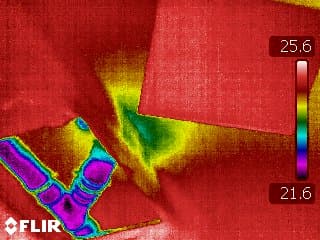
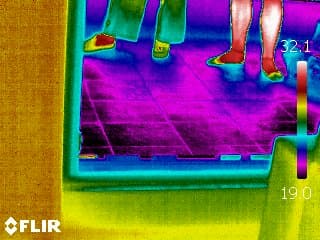
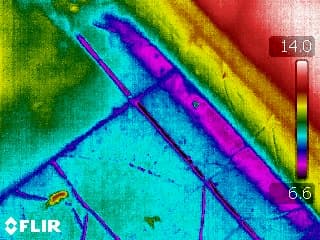
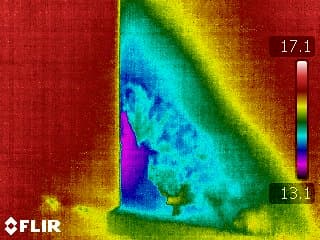
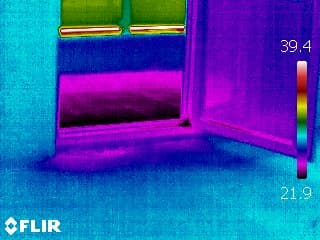
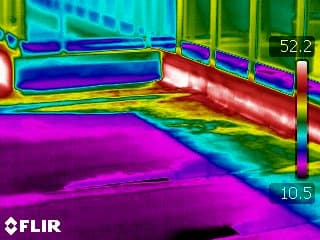
The world leader in infrared thermography. The camera captures heat emissions invisible to the eye and renders a detailed temperature map of surfaces. Damp zones change the thermal conductivity of materials and appear immediately as distinct “cold patches”, outlining the precise boundaries of the problem.
2. Moisture meters
The benchmark in non-destructive moisture measurement. Professional moisture instruments let us measure the exact percentage of moisture at depth in building materials (concrete, plaster, screed, plasterboard, tiles) without drilling or damaging surfaces. Through them we distinguish surface condensation from deep, standing or active damp.
3. CCTV survey cameras
Flexible endoscopic and robotic cameras at high resolution. They let us inspect the inside of pipework, drainage systems, traps and narrow shafts behind the damp zone, to check for internal cracks, fractures, settlement or blockages that may be overflowing.
4. Electronic stethoscopes and electro-acoustic microphones
Ultra-sensitive instruments that pick up the micro-structural sound waves and vibrations generated by water escaping under pressure. They help confirm whether damp found with FLIR and moisture meters is the consequence of an active, audible plumbing leak in the wall or the floor.
Why choose ProKanal EOOD for damp detection?
- Certified expertise: The diagnosis is carried out and analysed to strict European standards by our expert certified in Germany.
- 100% without demolition: We locate the source entirely non-destructively, sparing you dust, noise and breaking open.
- National coverage: We are based in Sofia, but travel for inspections and expert assessments across Bulgaria.
- Official technical report: We produce a detailed technical record with thermograms and the values from the measurements.
Don’t let hidden damp destroy your health and your property. Put your trust in the modern equipment and deep technical experience of ProKanal EOOD!
From our work
Frequently asked questions
What is the difference between condensation and an active leak?
Condensation is surface moisture caused by warm, humid air meeting a cold surface (a cold bridge, for instance). An active leak is water entering from inside the wall or the floor because of a plumbing fault or compromised waterproofing. By combining a FLIR thermal camera and a moisture meter, we can determine with 100% accuracy whether the damp is at the surface (condensation) or coming from depth (a leak).
How should I prepare the room before moisture measurement?
For maximum accuracy, the surfaces in the inspection zones must be dry (not wetted with water immediately before the inspection). If you suspect damp around central or underfloor heating pipes, it is advisable to switch the system on 2–3 hours before our team arrives, so that the temperature difference needed for the thermal camera is established.
Can your instruments detect rising damp in a basement or on a ground floor?
Yes. Our moisture meters measure moisture levels deep in the structure of concrete and masonry. From the characteristic distribution of the moisture and the temperature profile recorded by the thermal camera, our certified expert can identify the capillary rise of groundwater and give you guidance on waterproofing it correctly.
A leak — but where? A pipe — but where?
Our teams are on hand and ready to help.
+359 877 336 025Contact